Sun 07 Sep 2025
An early start was complicated only by Google Maps failing to work properly ( I discovered later that it doesn’t work in Kuwait or in Iraq). Fortunately the route was largely straight once I was out of the city, so I managed to make my way to the border without too much difficulty.
The Kuwaiti side was pretty straightforward. They took the piece of paper I had been given on entry, stamped my passport and, despite not having stamped my CdP on the way in, stamped it too.
The Iraqi side was a different story; there were eight different offices that had to be visited, some more than once. At the first, all my details were entered in a ledger. At the next a stamp was put in my passport, for my bike it turned out. Next, over to a collection of pre-fabs, accompanied by a fixer who had attached himself to me.
At the first, photocopying, office I was given two forms in Arabic to complete. The fixer didn’t speak English which meant he couldn’t really help. We went to Office No 1, where someone who did, took the forms and must have chased the fixer, because I never saw him again.
Anyway he completed the forms and directed me to Office No 2 to have the road tax assessed; then it was to Office No 3 to pay the tax, and then to Office No 4 to buy insurance. Finally a return to the photocopy office where everything was copied twice, and stapled together. Finally back to office No 1 to have one set retained and the remaining sheaf returned to me.
Immigration office was next where an iris scan was done, details entered into another computer, a visit to the “intelligence officer” and that was it, I was free to go.
Before going I decided to check my paperwork, and discovered that somewhere in the process, a visa had been stuck into my passport. I also noticed that the CdP had been stamped on the same page as the Kuwaiti exit stamp. Normally, in any country, the document is stamped on the same page for entry and exit. I returned to office No 1 to point this out and they assured me that everything was good and that on exit from Iraq, they would stamp over the Kuwaiti stamps. Not convinced but powerless to do aught else, I left and headed for the exit.
Here I was relieved of another sheaf of papers and then I was asked where my entry stamp was. Apparently this should have been on the page next to the visa. So, back to the passport office to get this done. Finally, 2½ hours after arriving I was through and on my way.
The road was in very good condition, especially when compared to the road before the border in Kuwait. The heat – by now it was 11:00 – was almost unbearable. Fortunately It was only 45 minutes to IEC, where I had been kindly offered accommodation by Paul Dunn, the Project Manager.
Here I got a welcome to match the air temperature, and very shortly was settled in my room. After a shower I met up with Paul for lunch where I met Neil, from Newtownards, and several other long term residents, one from Florida and another from Northern Iraq/Greece. Following this I retired to recover a little from the morning’s stress and exertions. We met up again for dinner and I finished the day by consolidating my route, based on the information I had gleaned.
Mon 08 Sep 2025

Today started well enough but this lasted all of 15 minutes. At the first checkpoint, 12 km into the day, I was stopped and told I had to use the highway; apparently the road ahead was mined. It was here that I realised I’d left my camel pack in the fridge, so I had to retrace my steps fully, to IEC, to recover it. Then back on the road and more desert views. Eventually I had to leave the highway and get onto the “mined” road; the mines were not of the explosive variety, but the potholes had obviously been actively excavated.
As I approached my destination, a city called Nasiriyah, I came to a checkpoint manned by guys in a variety of uniforms. After 15 minutes or so of standing around, I learned that we were waiting on someone to arrive. This finally happened and I was escorted to a small office and met a very pleasant man, whose name I didn’t learn.
He quizzed me in some detail, and I couldn’t, at first, decide if this was an official interrogation or genuine interest. I decided it was the former, but later, after he had written his short report, I think it changed to the usual Iraqi friendliness and hospitality. Whatever, the whole process took some 45 minutes, a delay I could have done without.
The road then brought me into the city, the ancient city of Ur. The traffic was horrendous, made life threatening by the widespread road closures, meaning all traffic was using one side of the 2-lane highway, which was even more pot-holed than the road leading into the city. The final 200 metres of the road to the hotel was blocked off by roadworks, which meant a detour of a couple of kilometres through narrow crowded side streets.
For a country the main export of which is oil, finding petrol is not easy, and only 87 octane is available, it seems! Although the science suggests this should be fine in the bike, I’ve been using 95 until now, so it’ll be interesting to see how the bike performs with this.
Tue 09 Sep 25
I wanted to leave especially early today as I was trying to get to my destination by 0830. I was couch-surfing tonight, and my host Hader left for work then, not returning until 1530. As it was still dark at 5 o’clock I delayed departure until about a quarter past when I could see without too much trouble. This meant I had to get to my destination without any hiccups.
Of course, it never works out that way and the main highway running north to Baghdad was in a dreadful state; it reminded me in places of the roads in Tanzania where there were two deep tram tracks made by the heavy trucks in the tarmac and once you got into one of them getting out was a hazardous affair.
In other places the road had potholes: longitude potholes, perpendicular potholes round potholes, long potholes and every other shape you can think of. These snuck up on you out of nowhere on an otherwise perfectly good road. In still other places the road undulated, and if I’d been on an airplane, the captain most certainly would have “turned on the seatbelt sign”.
This, alongside the race-track behaviour of the cars on the road – everybody travelled well above the speed limit, many weaving in and out from one side of the road to the other – made for a particularly hazardous ride. I opted for safety and cruised along at about 80 to 90 kph resigning myself to the fact that I wasn’t going to make the 0830 deadline; “Better late than late,” as the Zimbabweans say.
I stopped in a rest area to send a message to Hader to let him know of this and was, I’m not sure if welcomed is a strong enough word and fed by one guy and bought tea by another. Everyone was extremely friendly, mainly just wanting to know where I was from and where I was going – the limit of their English – so my five-minute stop turned into about 45 minutes.
The road improved from here on and as soon as I turned off the highway it was much better. There were two checkpoints along the way both of which I cruised through and finally find myself in Naja only an hour and a half behind schedule. I deposited my bags at Hader’s, which was actually in Kufa, and then set out to find something to do for the next few hours.
The Great Mosque of Kufa, which has stood, in one shape or another snice the year 670 CE, was nearby, so I went to visit. The mosque houses the shrine to Ali ibn Abi Talib, the cousin and son-in-law to the Prophet who was assassinated in the mosque in 661 CE. Ali is believed by Shia Muslims to be their first Imam, and hence successor to the prophet Muhammad, while Sunni Muslims believe him the last of the “rightly-guided” caliphs. In either case he is highly revered in the Islamic faith, making this a major site of pilgrimage.
The mosque is one of the four dignified mosques, to which Muslims must travel. The site is also thought, in Islamic tradition, to have been the home of Noah, the place where he built his Ark and where the Great Flood started.


The place is huge, and capable of accommodating may times the number of visitors present during my visit. I visited the ornate shrine and then settled down to watch people come and go. One of the things, I think, that make mosques stand out as places of worship, is that is it perfectly acceptable to sleep on the floor; you can just lie down on the carpet, go to sleep and no one will disturb you. So, feeling the effects of my stressful early morning trip, that’s exactly what I did. I was woken up about an hour and a half later by young chap leading a prayer group.
Feeling somewhat refreshed, I set out to find some fuel, only to discover that motorbikes are not allowed on station forecourts. You must park outside and go to the pump with a container and then go fill up your tank wherever you’ve parked. In my case this involved four trips to and from the pump to fill up the tank.
I don’t know whether this is a local rule or whether it’s throughout Iraq, but then I remembered that yesterday they wanted me to park outside the fence on the footpath, but eventually let me in after I said my bike was too heavy to get it up onto the footpath. I learned from Hader that motorbikes were generally in poor condition, not highly regarded and that this ruling followed a fire on a forecourt involving a motorbike.
After failing to find a café where I could sit and have a drink, I headed to the only green space visible on the map, to while away a bit of time. This was labelled as the University of Kufa, but it turned out to be a government office. Any case I managed to talk my way into the grounds and found a grassy spot shaded by an acacia-like tree. The gentle breeze helped keep the temperature down, but it was still pretty unpleasant.
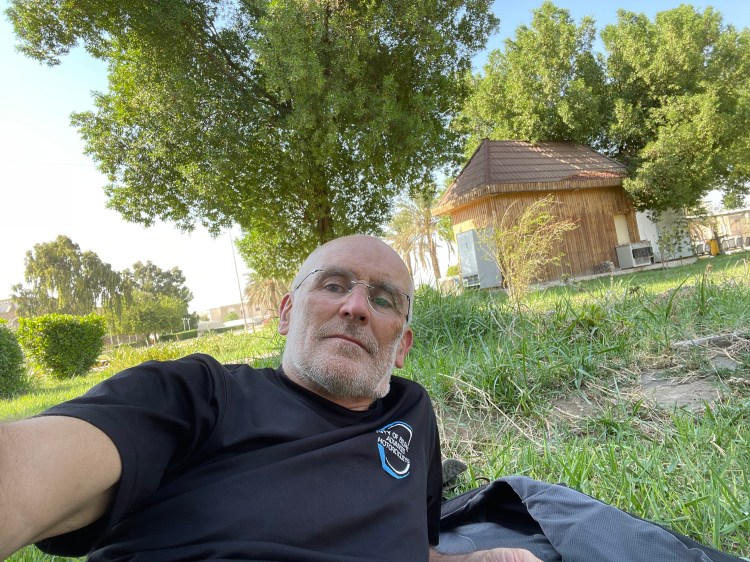
Although I had thought this yesterday, I decided that, since I’m not enjoying the high temperatures which make it impossible to do anything outdoors, I’m going to keep moving homewards as fast as possible. Looking at the weather forecast it seems that towards the end of the week, especially near the Turkish border, the temperature drops into the 30s which will be much more pleasant.
I met up with Hader a little later and settled into my room. We had a nice chat and some tea, and then I went out to have some dinner; this was a quite delicious chicken kebab. I subsequently decided that tomorrow I would leave at dawn, visit Babylon and then head straight to Baghdad.
Wed 10 Sep 2025
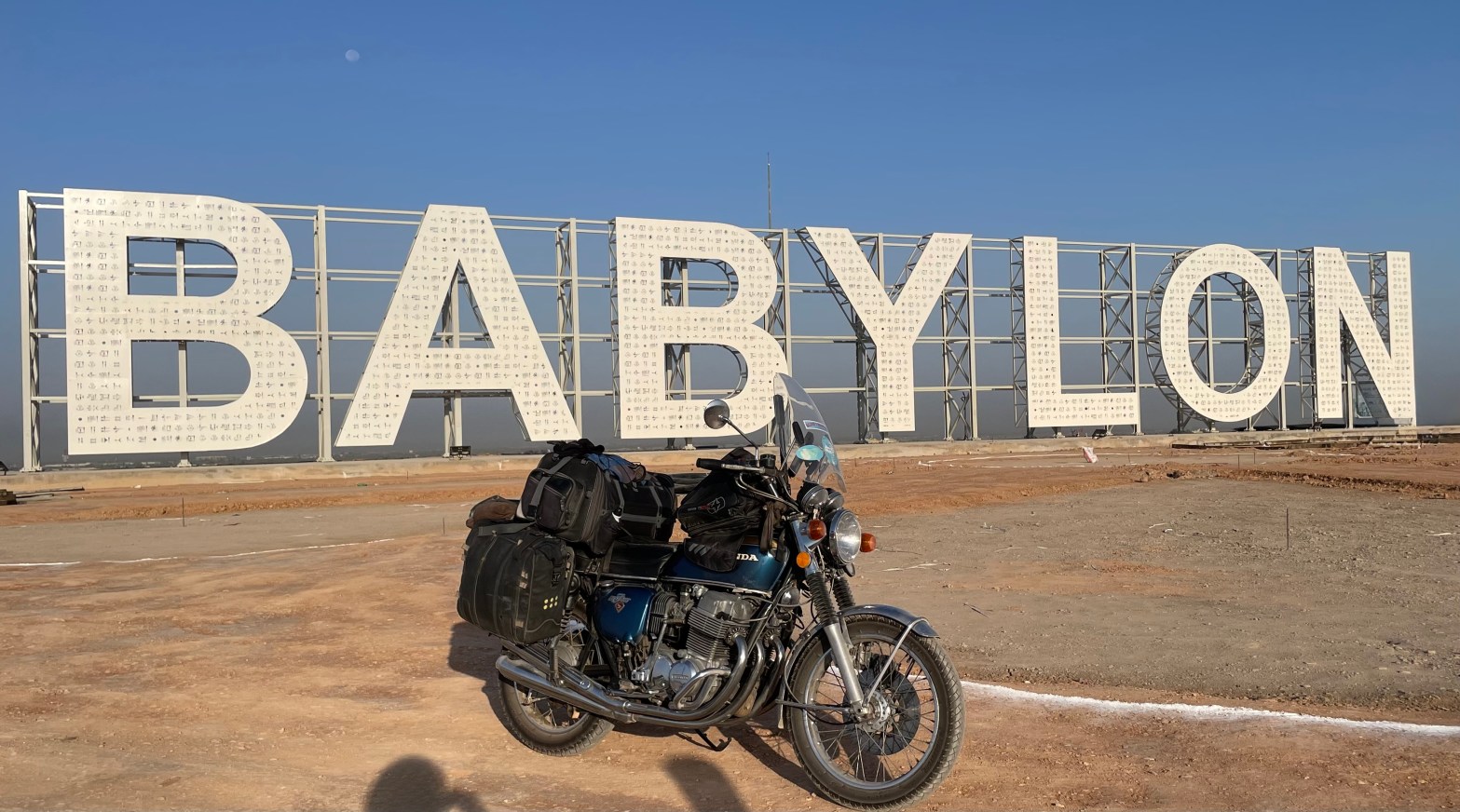
Well, I did just that. I arrived at Babylon about 0630, and of course it was closed! The guard told me that the person who issued passes would arrive in five minutes; twenty minutes after the five passed, I decided not to wait any longer. What I had seen already suggested that Ancient Babylon had been renovated, rather than restored, and I didn’t think that was worth hanging about for.

However, from the map it looked as if the remains of the Tower of Babel were accessible by a roundabout road, so I thought I might as well take a look. En route, I noticed the sign, Hollywood style on top of a mound.

I got a good view of the new Babylon from here, as well as a better view of the reconstruction.

That done, I packed my bags, so to speak, and headed to Baghdad. Before doing so, I came across the Tyrant Mural. Somewhat surprised, I stopped, expecting to see an image of Saddam Hussein. Nope!

I arrived in Baghdad at rush hour and Waze informed me that the remaining 7 kms were going to take me 45 minutes. Fortunately, for once, the traffic was moving in well-defined lines without much lane changing, so I was able to filter up the right along the bridge wall.
In the evening I took a stroll out to see Tahrir Square and find some dinner.
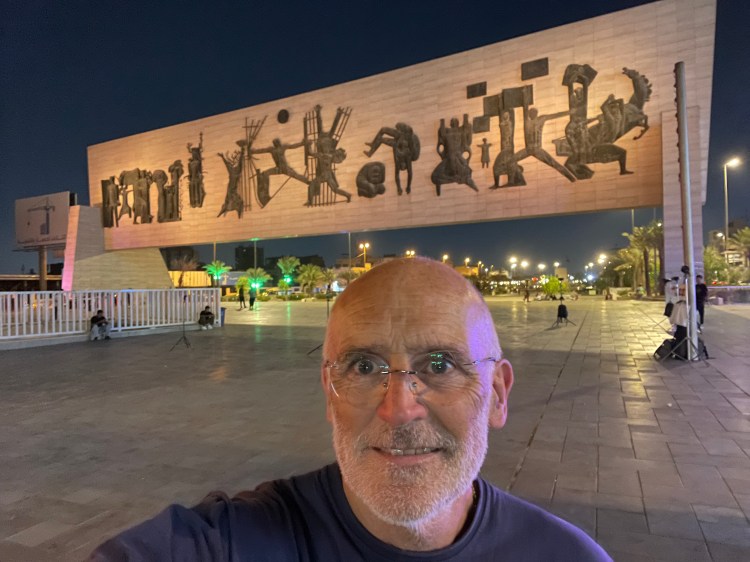

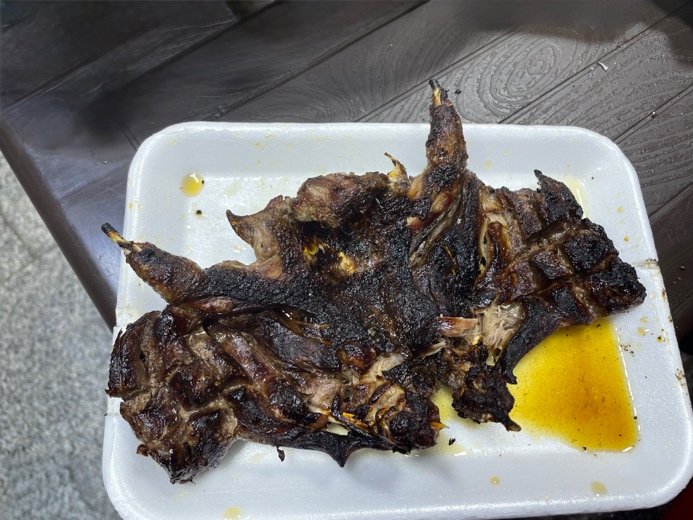
I met up with Mustafa, or maybe Omar as he said later. He was a retired engineer and took it on himself to help me find dinner. After a few tries, none of which appealed to me, he brought me to an establishment serving, according to him a great local delicacy and favourite – Tapan bird, he called it.
It didn’t look too appetising on the spit, but I thought maybe it was a bit like a quail, so I decided to live dangerously for a change.
Thur 11 Sep 2025
I left Baghdad early the next morning, and, after a few miles, noticed that it was really cool; there was a definite nip in the air. The countryside was flat, just like it had been in the south, but here it had patches of green and areas had clearly been cultivated, even if nothing was currently growing. The other thing I noticed was the greater numbers of police and army personnel around.
I also discovered what I though was a good ruse; as I approached a police checkpoint, I lifted my clear visor, leaving the sun visor down and was waved through. I repeated this at the next checkpoint and the same thing happened. I thought that, perhaps, seeing only the lower part of my face with a beard I was being taken for a local. My ruse “worked” once or twice more, but then I was disabused of this notion and subjected to another interrogation, though much less intense than the first one.

Then a hill, or rather a ridge appeared, and the road started to climb, for the first time in, what 2 000+ kilometres? 😊 It was now 0730, and the temperature was still pleasant. I was making good time, so I thought a stop for some breakfast was in order. I arrived in Kirkut at the end of my first day with a proper riding schedule; things are looking up!
 Belfast-2-Belfast-By-Bike
Love the power nap on the mosque floor story 🙂
LikeLike
The rugs are extremely well-suited for the purpose! 🙂
LikeLike