
Tue 11 Feb 2025
Because it was raining, I set off from Liz’s place towards midday, with a promise of dryer weather in the afternoon, and indeed I reached Blenheim with nothing more than a few sprinkles to bother me. The road was, as I had been warned, boring, with it’s only redeeming feature being, it was fast. I covered it in a little over 2½ hours including a prolonged fuel stop.
I filled up at a little private station attached to a workshop, with two very friendly owners. Here I also got something I couldn’t get in Pukekohe – spark plugs! Having replaced he plugs with my spare set I wanted to get another set, but none of the shops in Pukekohe, including the bike shops had the, what I thought were common, plugs. The lady owner boasted, when I enquired, that she had every plug under the sun; and, right enough, when I went to the rack, there they were! 😁
My destination was close to Belfast; I didn’t realise quite how close until after I had been welcomed by my hosts, Wallace and his wife Helen. Over a cup of tea, Wallace explained that the centre of Belfast was about 3km away. I decided I should start my research immediately.
Belfast, Canterbury, New Zealand
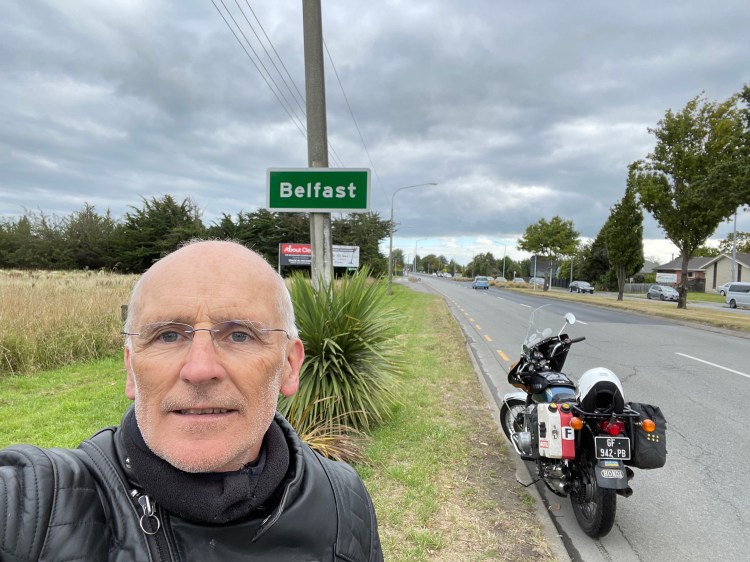
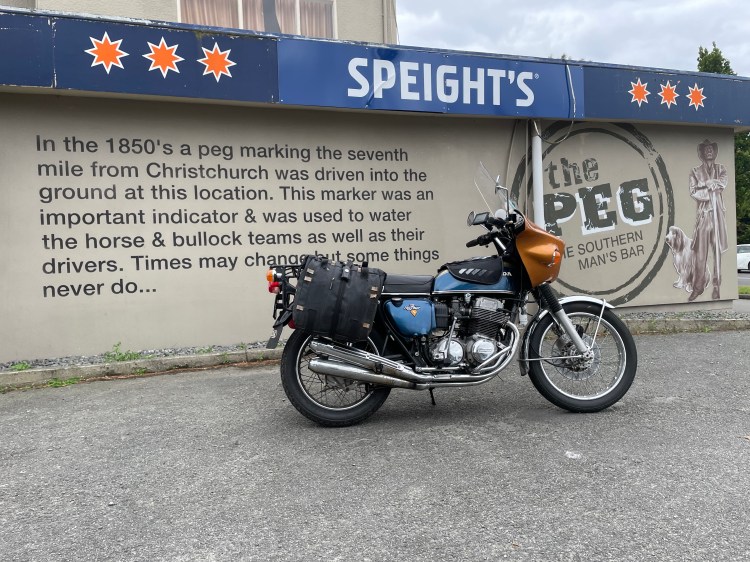
The first thing I saw in Belfast, apart from the sign, was The Peg – The Southern Man’s Bar. The photo below says all there is to be said; except that in the bar – not a place I’d necessarily recommend on a Friday night – I met a guy who is going to visit Belfast, NI in June.
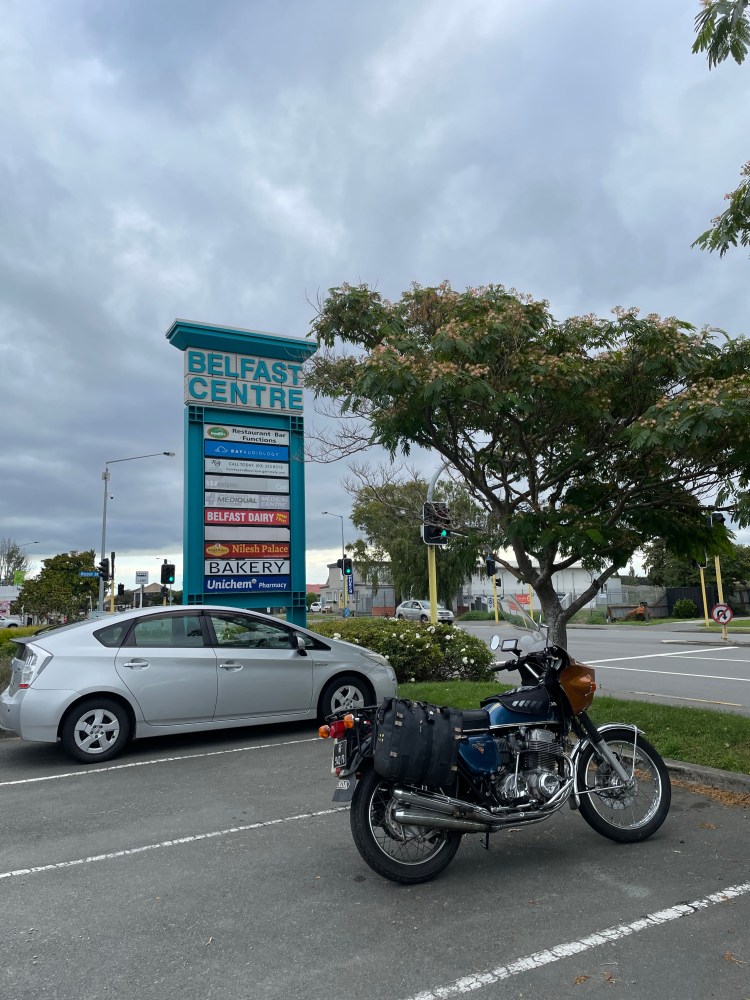
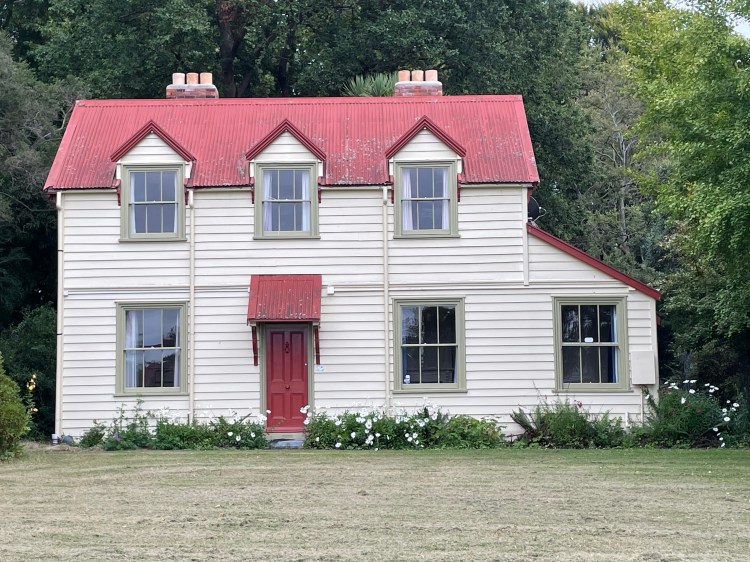
There is also a Belfast (Shopping) Centre, a Belfast Road, and, the relevance of which will become clear shortly, a Factory Road. Belfast has a District Historical Museum, housed in the Old Belfast Schoolhouse.

The Belfast Name
It seems to be agreed that the area was named after Belfast, NI, but just for a change, when and why is somewhat more contentious. My efforts in unravelling this mystery were greatly aided by Mr Dennis Hills, who has written a number of well-researched, pamphlet-sized books on Belfast and the surrounding areas, and by Annette, a librarian at Christchurch central library. I called Mr Hills and he kindly returned my call and gave me half-an-hour of his time to introduce me to Belfast’s history.
Belfast is situated about 6 miles north of the centre of Christchurch. It was established officially as a township in 1881-82, but the name “Belfast” was in use long before this event.
In 1872, one William Henry Mein established a boiling down plant, where animal carcasses were rendered to make things like tallow, and in 1873, this was purchased by a James McNeight-Watt. The latter converted the plant into a meat freezing factory and it was from this that the NZ meat freezing industry was born. Watt was from Belfast, NI and he named the factory “The Belfast Meat Factory”. However, there are two “howevers” in this story.
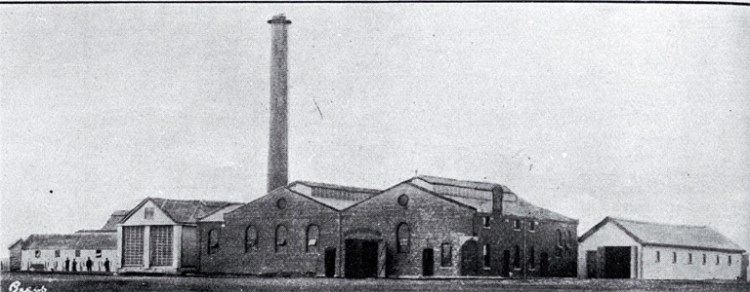
However No 1: The name “Belfast” was in use well before the establishment of the meat factory. Two newspaper advertisements offer accommodation at the Belfast Boarding House, one in Timaru, about 160 kms south of Christchurch, and the other, earlier one in Christchurch itself. The latter is dated 19 April 1871.
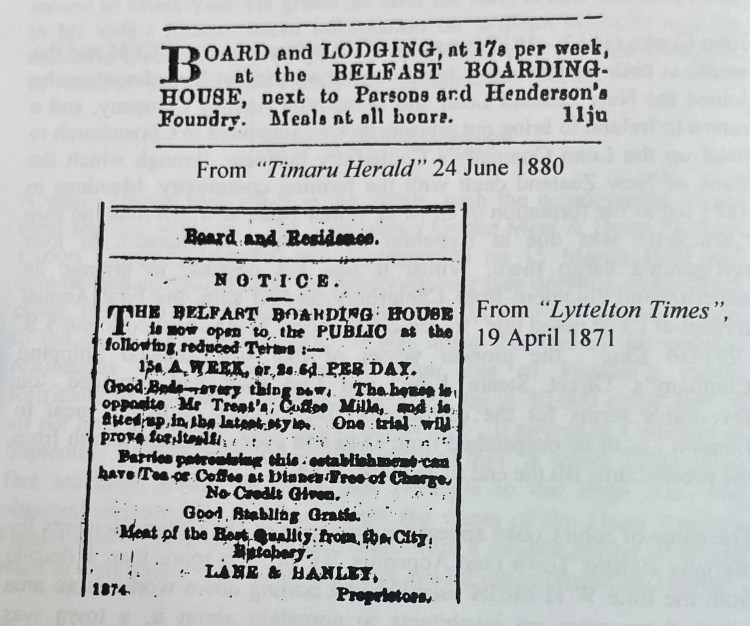
It is reported that many Irish immigrants named their business after Belfast.
However No 2: Whilst Watt made the first sub-division of the area, this was subsequently taken over by a loan company, and the manager of this company was one John Cooke, who, was responsible for a further sub-division, and who, you guessed it, also hailed from Belfast! 🙄 So maybe he is the guilty party?
However, – I know, that makes three – Mr Willis concludes his booklet – Hills, D. A. (Dennis Ashley), 1936-The Belfast Meat Factory pre-dated the township. D.A. & H.J. Hills, c2009 – from which much of this information comes by saying”
Let us leave the last words to George Ranald MacDONALD. Speaking of the Belfast Meat Factory, on the card for James McNeight WATT, he said,
‘It is probable that Watt’s Provision and Produce Company led to the district being called Belfast’.
Belfast is now a thriving community and suburb f Christchurch. The population is growing, there is a grand development plan and the future looks bright.
Wed 12 Feb 2025
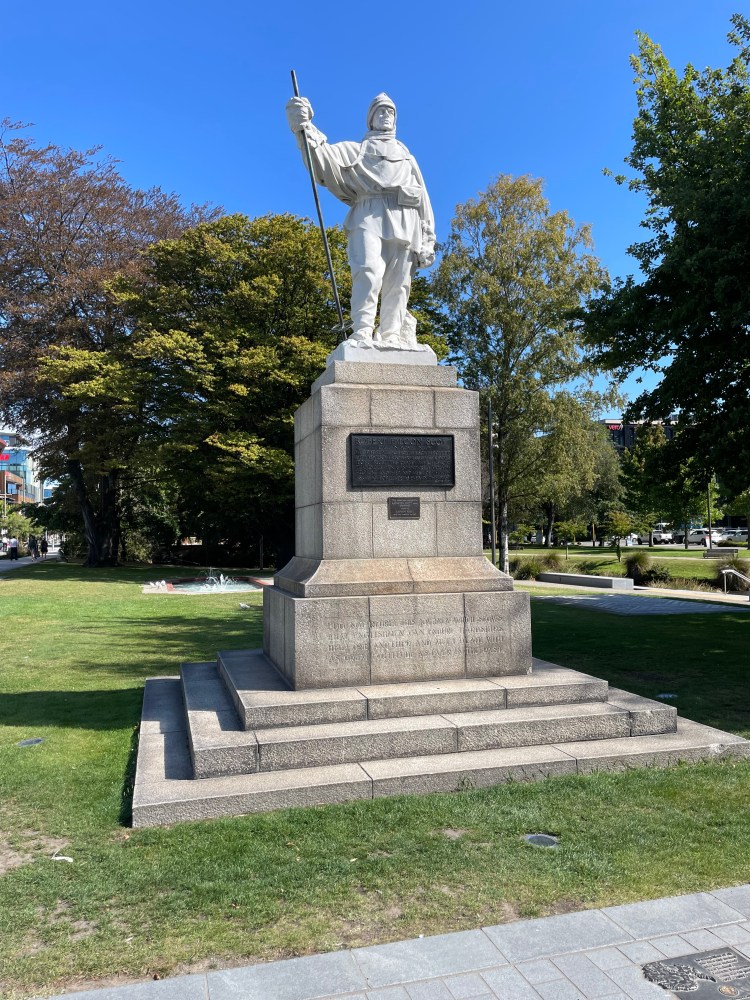
The next day, Wallace led me on a scenic ride around the Christchurch crater, showing off stunning views of Christchurch and its surrounding plain, and the crater itself. We had breakfast in Lyttleton, where the first settlers to the South Island landed, and where the Timeball that ushers in each new year is located.
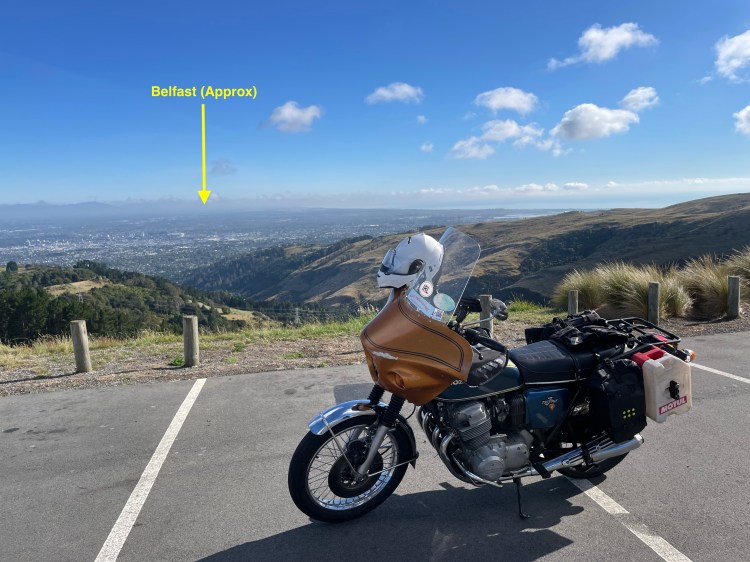
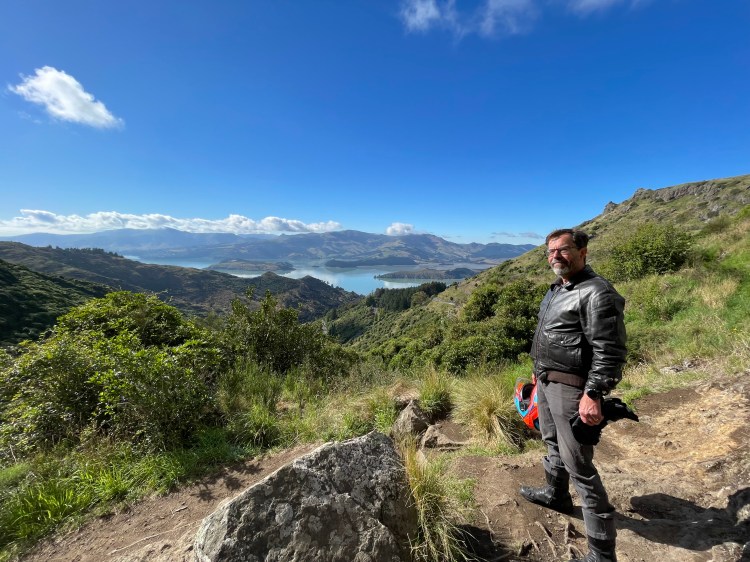
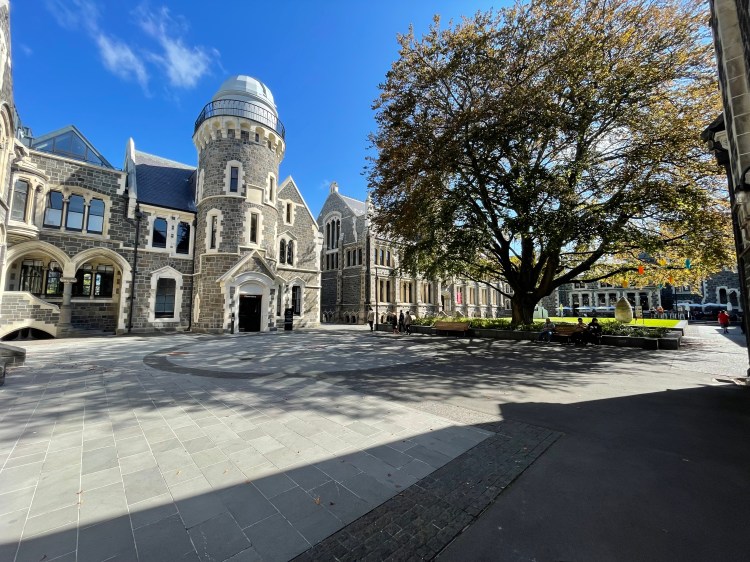
This was followed by lunch in the magnificent Christchurch Botanic Gardens with Libs and Ciaran, the daughter and grandson of my old friends, Brian and Jan Eadon, was followed by a visit to the library where I recovered in print form much of the information related above.
Thur 13 Feb 2025
So now the work here is finished and I’m on holiday! The first day of my holiday didn’t dawn bright and early.
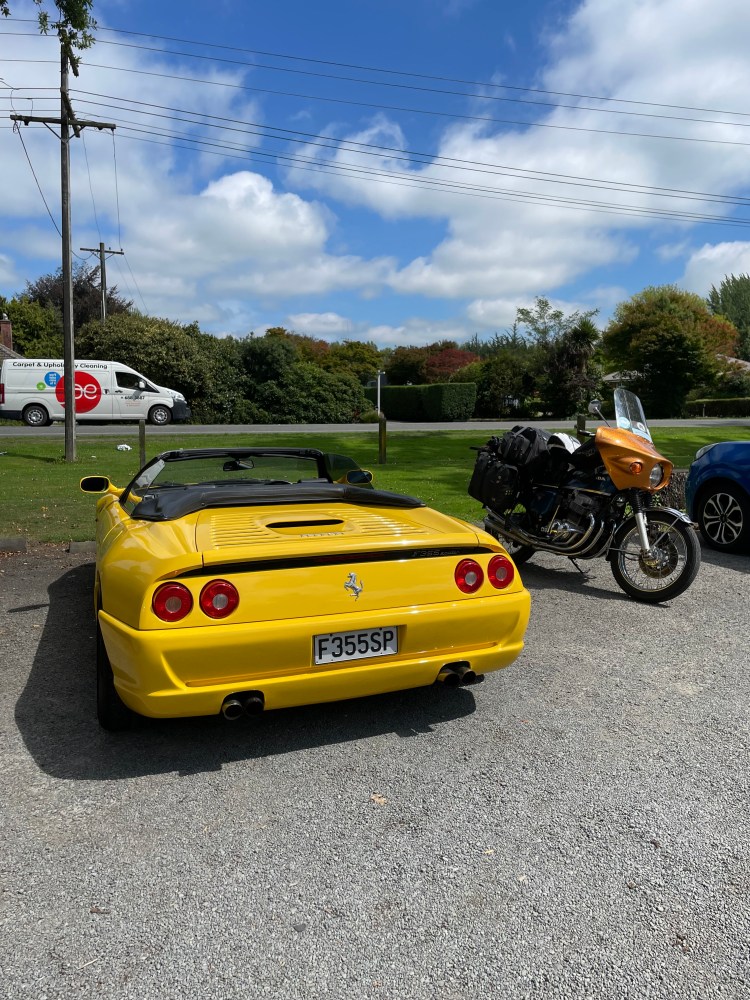
The area around Christchurch is flat, and I don’t mean just flat; it is flat, flat!! (See the photo above) That is boring enough, but the roads I started on joined in the chorus. It was straight; not the slightest deviation for nearly 35 kilometres. I kept going for 185 of the 250 kms just to get it over with and stopped for coffee in a little place called Geraldine, where I had the best chocolate éclair I’ve have in a looong time. Some guy parked an old banger next to me, and obviously thought this enhanced the appeal of his car, because he followed e to the petrol station.
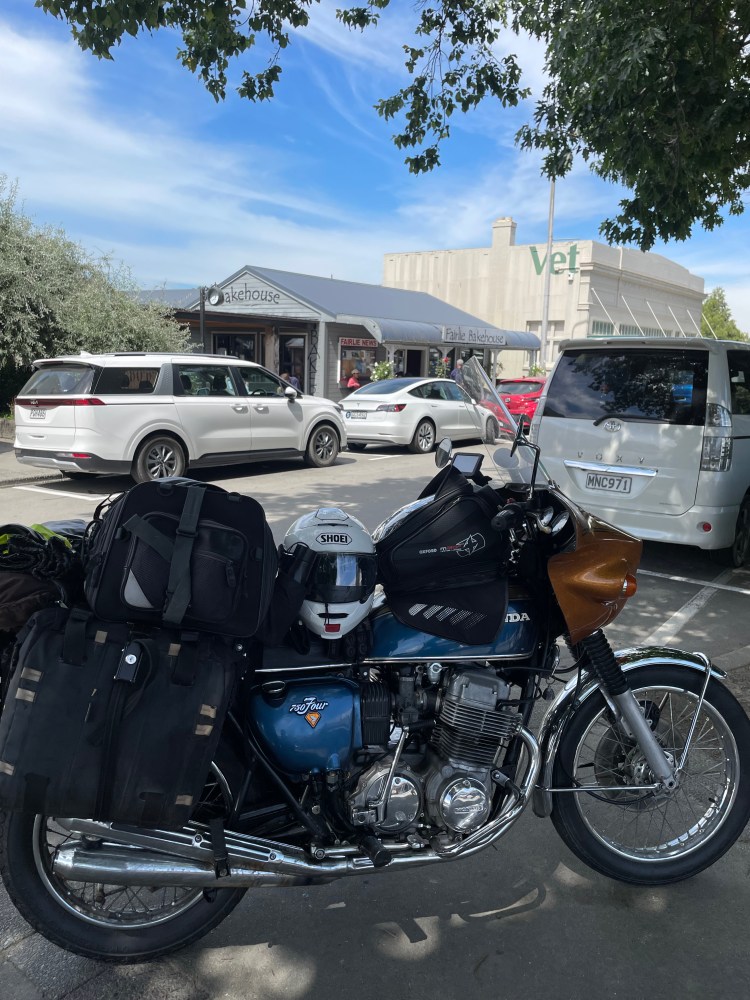
My next stop was in Fairlie, to where, I was told, people come from all over New Zealand for the pies. I didn’t know this, but apparently pies are the thing in NZ, and the country is famous for its pies: meat pies; curry pies; egg & bacon pies; in fact just about anything you can eat pies. Just goes to show … Anyway the Fairlie Bakery is the place to get a pie, so I duly stopped to see. Having just consumed a large creamy éclair, I wasn’t much in the mood for a pie. They didn’t have a full choice left, so I settled for a venison and cranberry pie, (I did say, “just about anything”) that I thought I’d have for breakfast.
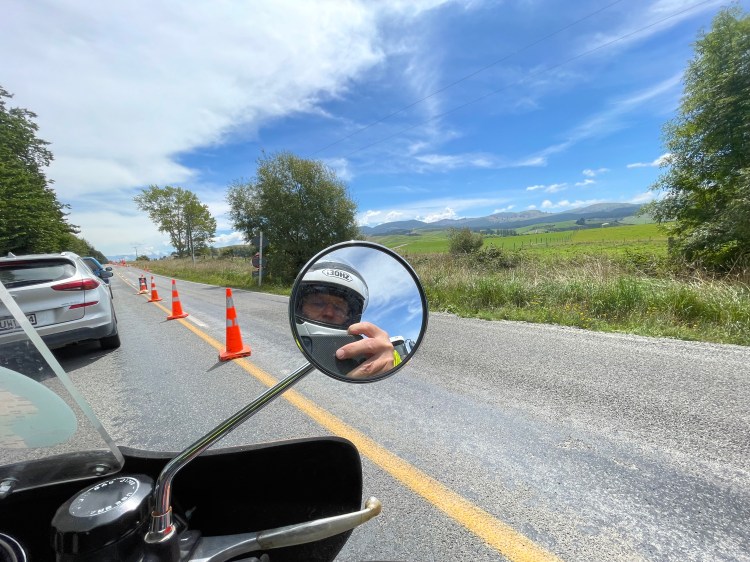
As I was riding along admiring the scenery, I wondered, “When does a hill become a mountain?” New Zealand does have magnificent scenery – sparkling lakes, rolling grassy hills, wooded slopes and steep majestic mountains – as we all know; it also has roadworks! Lots of roadworks.
The answer to my question, I found here: Ultimate Kilimanjaro
| Hills | Mountains |
| have an elevation usually below 2,000 feet (610 meters) | have an elevation usually above 2,000 feet (610 meters) |
| rise gently from surrounding terrain | have more dramatic slopes and are more prominent |
| have a smoother profile and are usually less steep compared to mountains | often feature rugged terrain, including peaks and ridges |
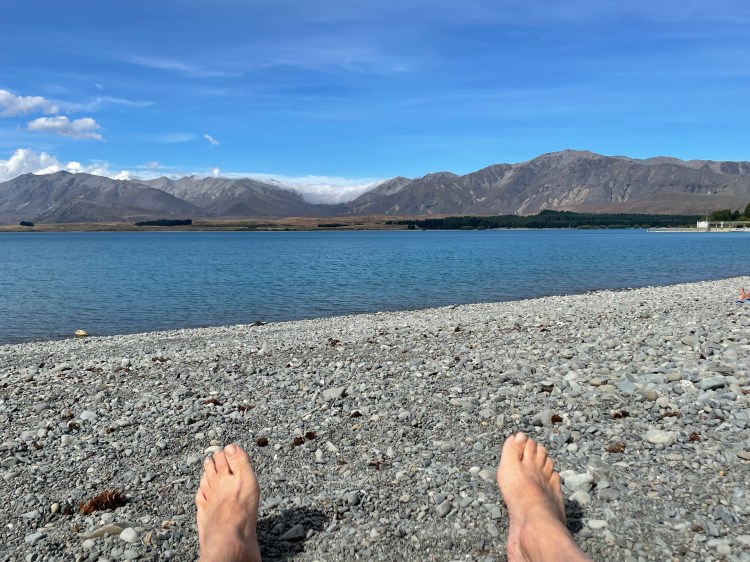
The ride and the weather improved after this and I arrived at Lake Tekapo, in the Dark Sky Reserve in good time for a bracing swim in the lake – it did get more pleasant once I was, or maybe I just stopped feeling the cold as much.
I as staying the night at a backpacker lodge and I have to say I was impressed with the standard and cleanliness. The kitchen was spotless and equipped with everything you would need to make a family Sunday roast! I just hope my roommate, a young German lad suffering from a hangover, doesn’t snore.
On towards Dunedin and my old mate, Davy McBride, with whom I did my very first overseas trip to France!
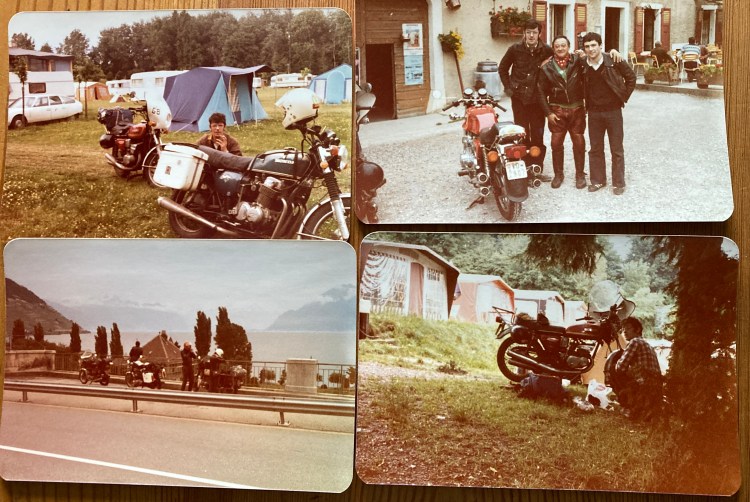
Yep! Same bike!! 😁
 Belfast-2-Belfast-By-Bike