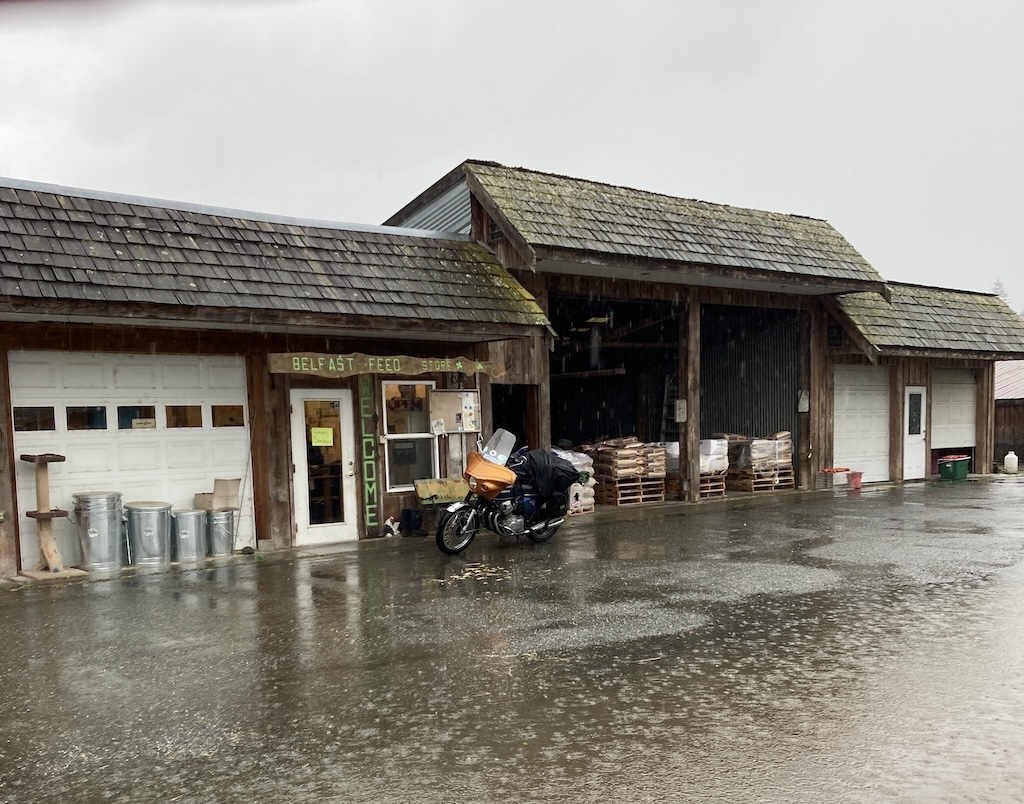
I arrived in Belfast, Washington on a wet Tuesday afternoon that made Belfast, NI look like the Atacama Desert (the driest place on earth). It had been raining for the previous 3 hours, and as I approached through the interestingly named Sedona-Woolley, the rain intensified. It was like standing under a waterfall, and when I started riding again, I could feel the rain hitting my boots.
As I rode along Old Highway 99, the track of the railway line, I searched for a signpost naming the location in vain. Maybe this was because the rain was still streaming down and I could barely see where I was going; taking my eyes off the road to look for a signpost was hazardous, to put it mildly. Or maybe there was no sign. 🤷🏻
I crossed the bridge mentioned in the referenced document and then on the east side of the road I saw a sign for Belfast Feed Mill. This was the only remaining, readily visible sign that the area was once called Belfast. I rode to the crossroads and followed each road for a short while, but seeing nothing of interest I returned to the Feed Mill.

My intention was to take a photo of me and the sign and then get to somewhere I could dry out – I had long ago decided that camping was out of the question. Instead, I rode into the compound and saw a little shop with a sign. Having foolishly ridden through the pond that had replaced the yard – you never know how deep a pool of water is – I parked as close to the front door as I could.

I was greeted by a voice that I subsequently learned belonged to Cindy Jacobson, who, with her mother, Kathy Curry, ran the store that had bought and opened in 2004. They retained the name and erected the sign which resulted in many different people sending or giving them things relating the history of Belfast.

Belfast, Washington
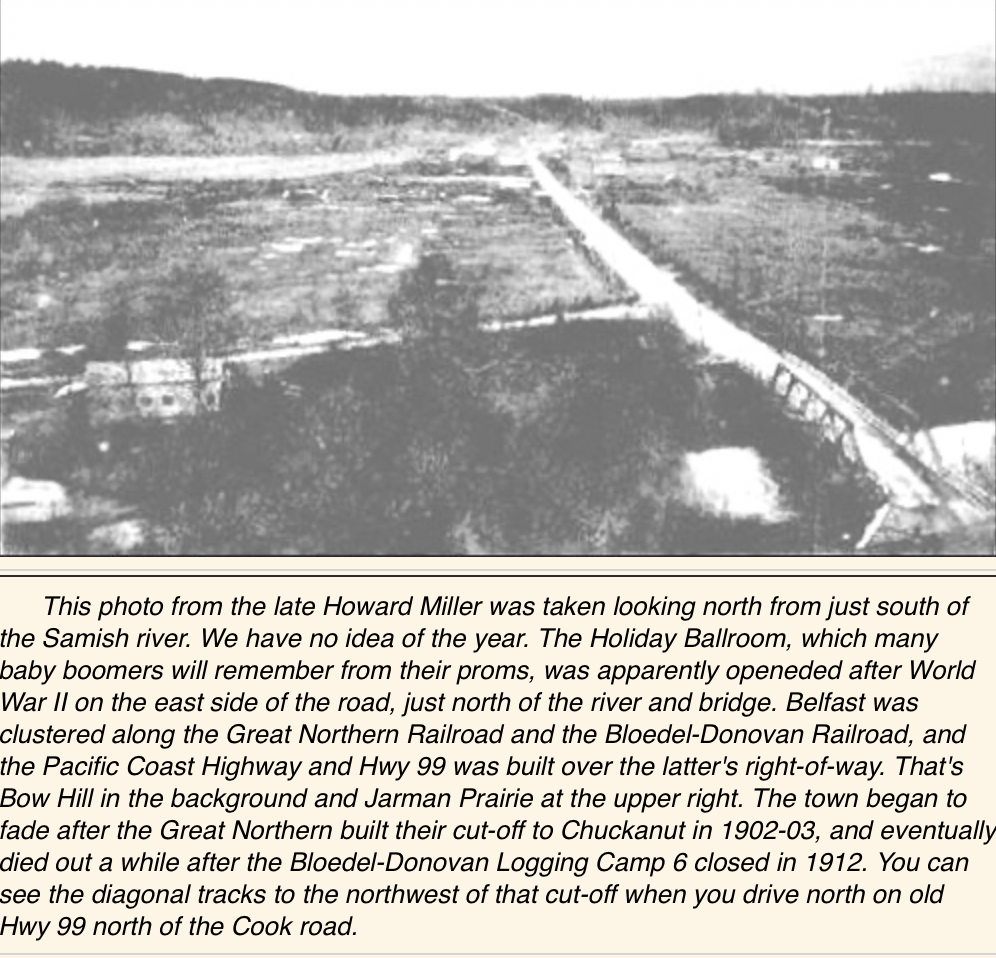
In common with several other Belfasts, this one developed around a railway junction. William Gilmore, Sr., pioneer merchant of Edison, was the father of Belfast according to one of his early day friends, B.F. Smith. He supplied the Belfast area in the earlier days and expecting a large town to sprout up with the coming of the railroad financed several businesses there. And since he was a native of Belfast, Ireland, he named the place for his hometown. (Source: Skagit River Journal)
I couldn’t find the exact date of Belfast’s founding, but it was around 1888/90. Whatever the case, when the existing railway was extended and passed through Belfast, the stage was set for Belfast’s rapid expansion. In it’s heyday, it boasted a hotel, restaurant, saloons, a railway depot and, at some point, a school which was still operating as late as 1928.
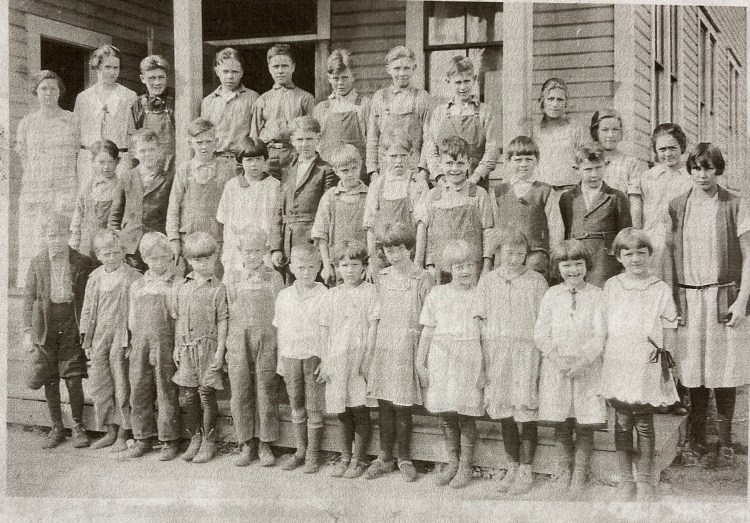

When the logging operations that were the main industry in the area ceased, and the railway passenger services were stopped, the fate of Belfast was sealed. This occurred around 1912.
Now all that remains is the Belfast Feed Mill which is located about 1 km north of the old railway bridge – Old Highway 99 was built along the track of the railway line. An original farmhouse, built around 1902 is in the same compound as the store.

So that is the penultimate Belfast on my N American odyssey. I headed south to find the chosen hotel in Mount Vernon. I arrived, dripping water all over the lobby, and shortly afterwards, my room was draped with the contents of my non-waterproof bags and my rain gear; I actually had to empty water out of my jacket pockets and my tank bag.. With the air-conditioner turned up to high heat, the room very quickly became more like a Turkish bath than a hotel room.
The rain stopped about 2200, as I was thinking about bed. Tomorrow has to be a better day!
 Belfast-2-Belfast-By-Bike