20 April 2019
Just for a change I left Dee & John’s later than planned, but I was well fuelled and raring to go. During my runaround on the Rand, the clutch had started slipping. This only happened first thing when it was cold; I couldn’t think of a logical reason for this, but it seems to be not unusual. Anyway it was solved by a simple adjustment and I was happy to see that pulling up the hill this morning caused no problems.
I had also used some handlebar risers to, yes you guessed it, raise my bars a bit. I wanted to bring them back more than up and I was keen to see what effect raising them had. I think I would have taken it a bit further, but the limit of my brake hose had been reached with a raise of 15mm.
Rather like Robert Pirsig, my preference is to avoid highways, sticking to secondary roads. So far this hadn’t been much of an issue because there are no highways in either Zimbabwe or Botswana, and I had successfully avoided the N1 en route to Pretoria. Now I tried to avoid the N4 towards Belfast.
It was not to be. Oh, I didn’t mention that while perusing maps during the week, I had come across another two places called Belfast; the first was about 90km north and appeared on some maps as
KwaMhlanga (at the junction of the R573 and R568) and the other near the Kruger Gate on the R536 – both actually appear on Google Maps, although one appears only as Kwa Mhlanga.

I thought I would visit all three, just for completeness’ sake, but my GPS wouldn’t cooperate. I was still struggling with the new mapping software I had loaded the previous day, and after 30 minutes trying fruitlessly to establish exactly where I was, I gave up and decided to head directly for EMakhazeni, as Belfast is now known, in order to arrive in good time to set up camp for the night; this proved to be a good decision.
There is not much to say about the ride to Belfast, except that once again my GPS failed and I ended up on the N4 Toll road heading east. It wouldn’t be outrageous paying the R60 toll if the road was in good condition, but it wasn’t. The surface was uneven, potholes poorly fixed and there were ridges between sections. However we might complain about Zimbabwe roads, the fact remains that intercity roads are actually very good – free for motorbikes too – and certainly better than the stretch of N4 between Middleburg and Belfast!
To say Belfast is a bit of a disappointment is something of an understatement. I passed through looking for a place to pitch my tent. Eventually came across a somewhat rundown looking guest house called The Bell. Even though the front door was open – security gate mind – there was no-one home. Some guys across the road said it was closed at weekends and directed me to another establishment. This was full. Then I got chatting to the folk who lived next door and they kindly phoned around for me to see if anywhere close was open or available; mind you, at the same time they said there is nowhere safe to camp in Belfast, and really nowhere to stay apart from the place next door. The result? They directed me to the campsite in Dullstroom, at the dam some 33 km further on.
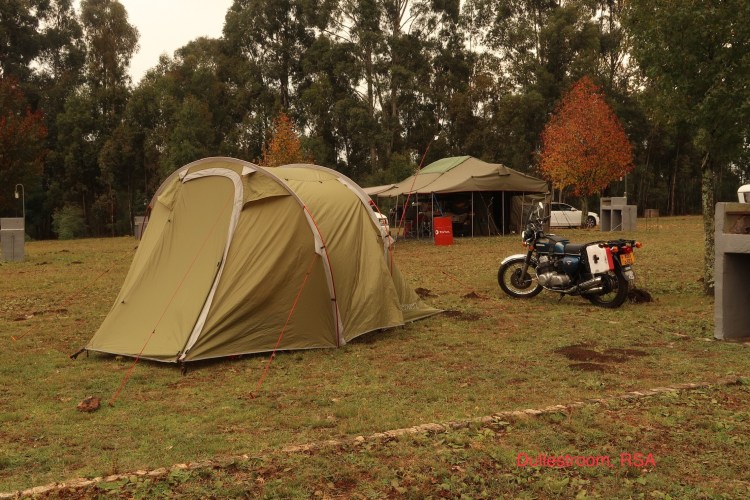
So I headed up the road and got myself settled in:

I spent a rather chilly night in what I learned is the highest residential town in SA. But it was an interesting evening; I had a visit from a neighbour, Stefan, who runs, of all things, a tinker’s shop in Dullstroom. My next visitor was Henry Oechler, who hails from Mexico, runs a Mohair shop in town and, it seemed, drove out from town just to see my bike! He rides an Africa Twin himself and has flown a micro-light around South Africa! You do meet the nicest people on a Honda! (Google it!) The camp site at the dam is fine, basic, but fine. Ablutions were clean and the only things missing were a bin at the pitch and a mirror in the ablution block. The contrast between camping SA style

and camping Irish style was …. noticeable! 🙂
Belfast, RSA – 21 April 2019
Anyway, after a breakfast of last nights leftovers, and things had dried out, I set off for Belfast, or rather tried to; it took me several minutes to work out why the bike would only roll forward half-a-meter – like there was a stone under the wheel. Mild consternation when there was none in evidence. Then I remembered!
The previous evening I had been warned by a horse riding lady – no name – that three bikes had been stolen the night before so I needed to take care. My only options were to park the bike in the tent – bit of a schlepp – or use my luggage security cable to make rolling the bike away a little more difficult. Guess which I did! It worked very well – the bike was still there next morning. 
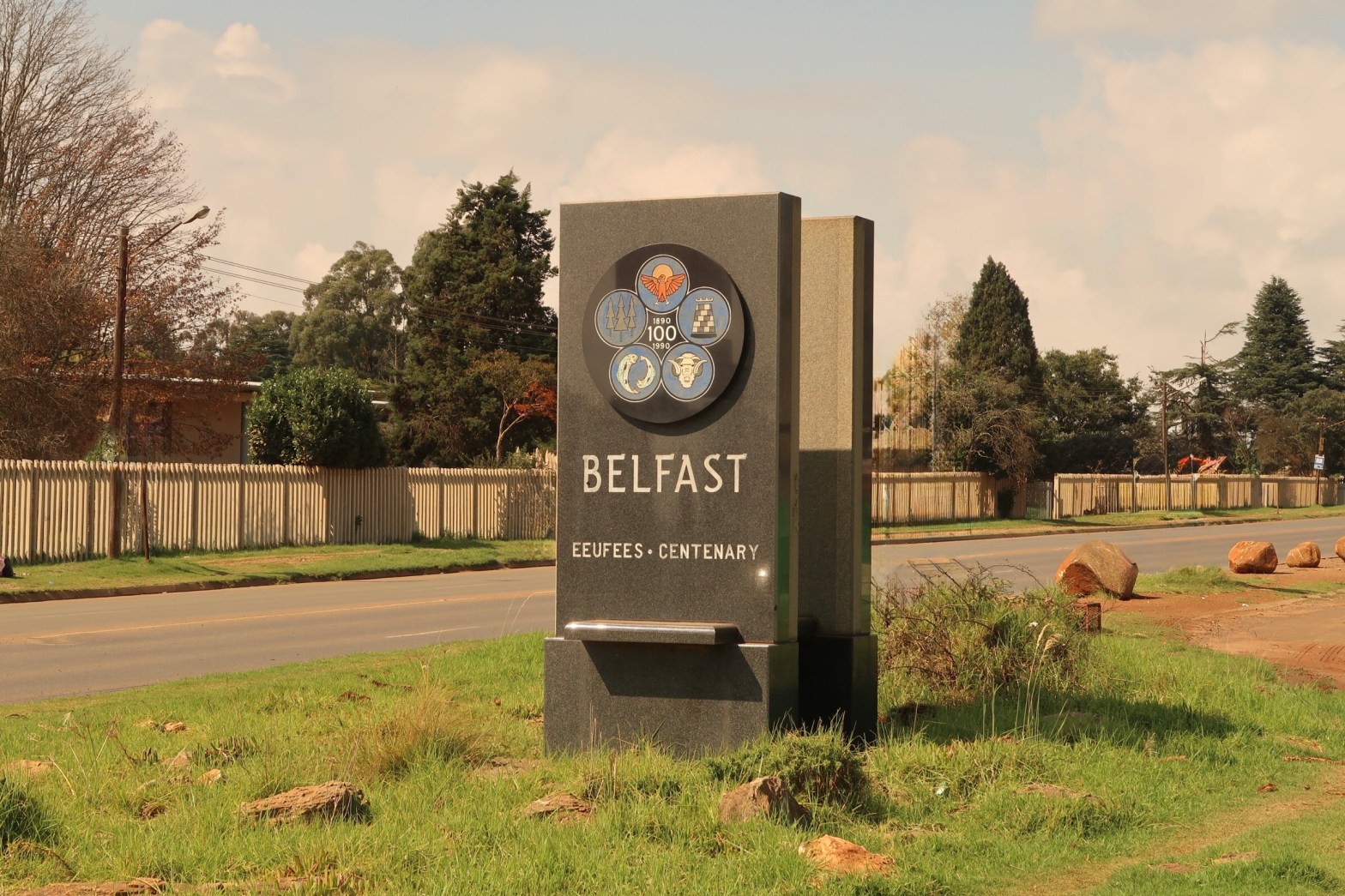
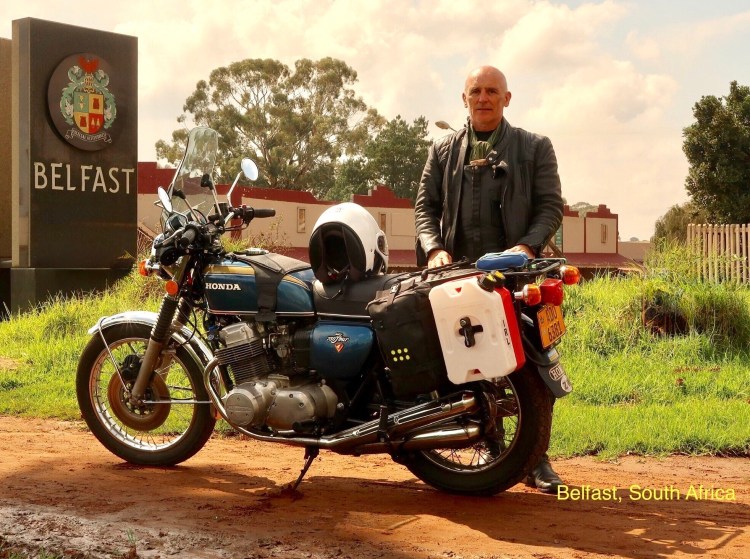
The road to Belfast is in better condition than parts of the N4! And so here I am – 38 years older and arguably none-the-wiser – on Easter Sunday morning, in Belfast, Mpumalanga, sitting, of all places, in KFC. Why? I’m having a coffee while waiting for the sun to shift so I can take a photo of the only thing there is to photograph in Belfast – the town sign, and even that is defaced – and catching up on the blog.
| A Short History of Belfast Belfast was established in 1890 at the request of one Richard Charles O’Neill – the 3rd holder of the name – who was a grandson of an Irishman, who arrived in South Africa in 1817. The circumstances of the grandfather’s joining the British Army and leaving his native Belfast are unclear. However he served in the Royal African Corps, which, allegedly, was made up of society’s less desirable individuals. The family history can be traced to 360 AD, and throughout the middle ages, the O’Neill’s were prominent in Irish affairs with fluctuating relations with the English; Hugh O’Neill was one of the Irish leaders who “flew” to Spain in 1607. Joining the Great Trek in 1838, the family established themselves in present-day Kwazulu-Natal, near Volksrust, and sided with the Boers during both Anglo-Boer wars; it was at O’Neill’s Cottage that the surrender of the British was negotiated after the Battle of Majuba Hill in 1881. This short history might lead one to believe that Richard Charles (I) joined-up and left Belfast under forced circumstances, rather than of his own volition. Richard Charles (III)’s father, John James, moved north in 1871 and settled in present-day Mpumalanga in 1873. The latter appears to have been a successful farmer and businessman and in 1883 acquired his first farm, namely Tweefontein. During the mid to late 1880s the numbers of farmers in the area increased and the need for a town was felt. In 1889 the community asked Richard Charles (III) to request the government of the Zuid-Afrikaansche Republiek to establish a new town on his farm. Richard Charles O’Neil proposed the name ‘Belfast’ in honour of his grandfather who was born in Belfast, Northern Ireland. According to Van der Merwe (1952) three main reasons were given why Tweefontein would be the best site for the new town: – On the 16th of December 1886 a monument was officially opened on the farm to commemorate the Battle of Blood River. The monument soon became the place where local farmers could gather during special events or festivals. – A strong need was felt for the establishment of a church roughly in the middle between the towns of Middelburg and Lydenburg. The farm Tweefontein fitted this requirement. – The discovery of coal and subsequent establishment of a number of coal mines all around the farm Tweefontein meant that a town on this farm would be centrally located within this wider mining area. The first survey work for the town was undertaken in 1889 by Peter Macdonald, and on the 30th of July 1890 the town was officially proclaimed by President Paul Kruger.Sources: Personal communication with Darryl Boswell, direct descendant of RC O’Neill.http://samilitaryhistory.org/99/d99aprne.html `https://sahris.sahra.org.za/sites/default/files/heritagereports/SKMBT_5013041211200.pdf |
Belfast is a typical South African rural town; busy, even on Easter Sunday, but with shops etc you’d use only if you didn’t have access to somewhere else.
Belfast used to have an establishment called the Royal Hotel, to which, in it’s heyday, people were ferried from the train station by carriage. After riding through the town a couple of times, I eventually found it; it’s right opposite the aforementioned town sign.

How did I find it? I asked Eris, a chap from Zimbabwe, who stopped to talk on seeing my number plate; Eris is one of many economic migrants one meets in SA, and I was to meet another 10 minutes later. The hotel was on the opposite side of the crossroads, but quite unprepossessing and with no markings. According to Eris, it was closed down after it became a drug dealing centre ruled by Nigerians and, although still operating, was not recommended.
So whilst having my coffee – KFC was recommended by Eris as the only place in town to have “real” coffee – I asked some local folk what I must see before leaving town, and the answers were all ….. a long time coming and were then negative. So I’m off to photograph the sign and then the journey really begins 🙂
Back to Dullstroom just in time to shelter from a thunderstorm. Dullstroom, a one street town that in 1989 boasted only a single petrol pump, a corner café and an hotel; now it is a tourist-magnet to rival any. A 2km long street of curio shops, boutiques, cafés, restaurants, catering for the upmarket, white tourist trade from Mpumalanga and Gauteng; also hosts a serious number of bikers; also upmarket, mainly on big dual-purpose BMWs, Harleys and other armchair cruisers. Still it’s a major improvement on Belfast. I spent a very wet afternoon wandering the street and sheltering from the downpours.
I checked online and apparently Mrs Simpson’s is the place to eat in Dullstroom; I called in earlier and a very pleasant guy offered to fit me in at the bar, since I was a single – there are some advantages after all. This turned out to be a major score – see review below – and I even got my own table; I think the fog might have had something to do with my good fortune.

Whatever the reason, I had the best restaurant meal I have had in a long time. I was so impressed I did a TripAdvisor review. I drifted home with the mist, and hoped the weather would improve by tomorrow.
 Belfast-2-Belfast-By-Bike